From American Lutherie 154 (2025)
Finishing is probably my least favorite part of the guitarmaking process. I use a gloss finish, and getting there involves shooting multiple coats of finish, sanding in between coats to fill the pores and level off the (inevitable for me) drips or sags. The sanding in particular is time-consuming and repetitive, and more than once I’ve thought I had sprayed my final coat only to inadvertently sand through in a spot and have to either re-spray or attempt a spot fix (which is time consuming in itself). Thus I’m always looking for any way to improve this process – anything that might reduce the time I spend sanding or help produce better results.
I stumbled across Super Assilex sandpaper when researching whether wet-sanding was OK or not for water-based finishes. (As usual, it depends on who you ask, but the manufacturers generally say not to wet-sand.) Modern water-based finishes, like the Target EmTech EM6000 and General Finishes High-Performance Water-Based Topcoat that I use, have really evolved, to the point where they perform better than solvent-based finishes in many regards. One thing that I really like about them is their dry-sandability. Early water-based finishes, and many solvent-based ones, tend to clog sandpaper relatively quickly when dry sanding. But the latest water-based finishes have an amazing tendency to cleanly powder and not clog the paper, making them much easier to sand. However, dry sanding doesn’t have water to act as a lubricant and cushion, and thus tends to leave deeper scratches, especially where the edge of a sheet of sandpaper contacts the work. This can leave frustrating scratches that don’t show up until you’re a few grits along, requiring you to go back and spot-resand where needed. Hence my original search to see if wet-sanding is permissible for water-based finishes to help eliminate scratches.
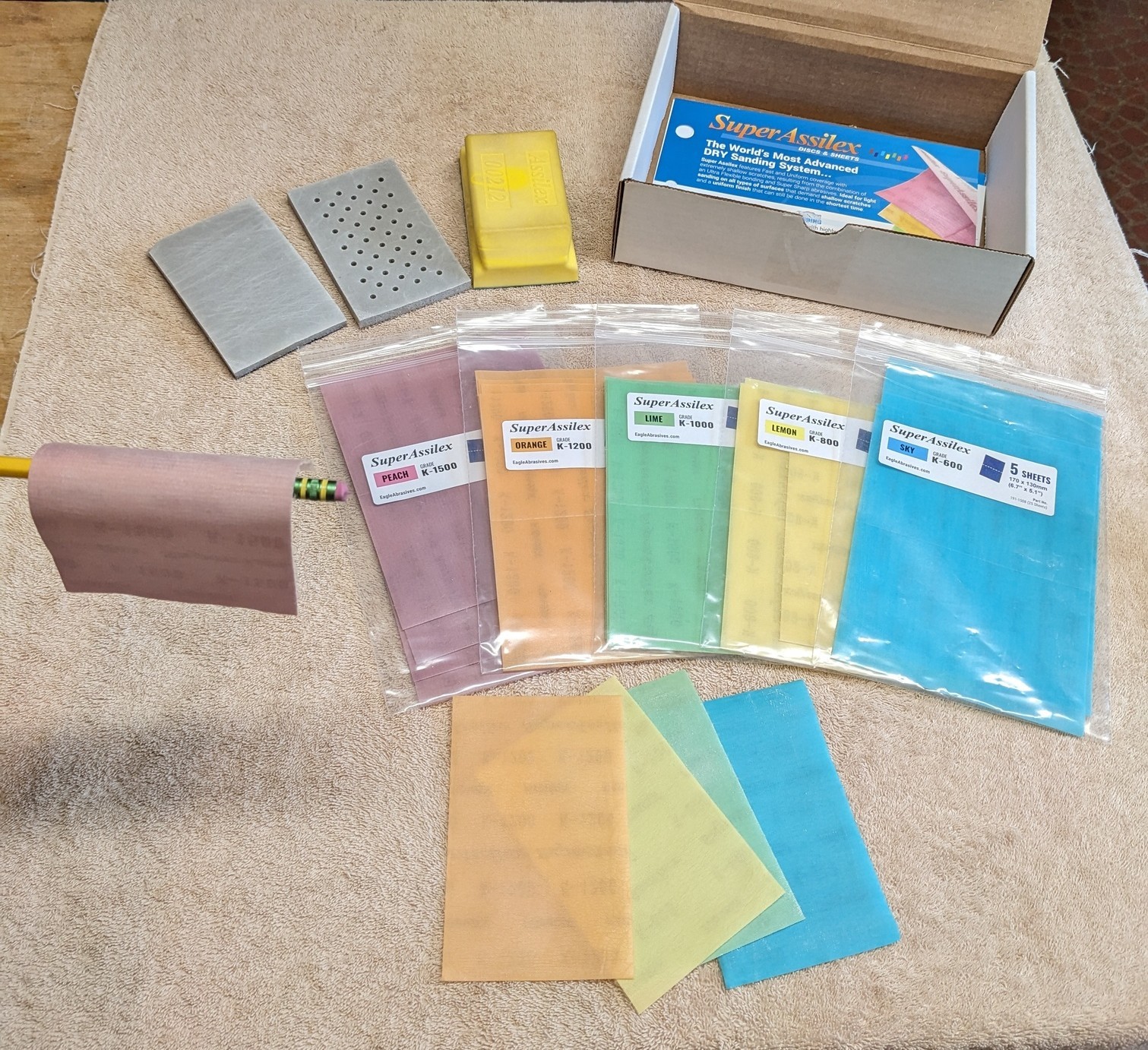
What I discovered instead was something way better – a new type of sandpaper called Super Assilex, from Eagle Abrasives, Inc. I hesitate to call it sandpaper because the abrasive sheets aren’t paper – they’re some sort of very thin, soft, flexible polymer. As such, there aren’t any stiff edges or corners to dig in and leave scratches. In fact, the sheets are so thin that you really need to use a backer to effectively hold them. The Starter Kit contains a selection of grits from 600 through 1500, and a sanding block and backing pads with a hook and loop type surface for attaching the sheets. Figure 1 shows the starter kit, with one of the sheets of “paper” draped over a pencil to show how flexible it is.
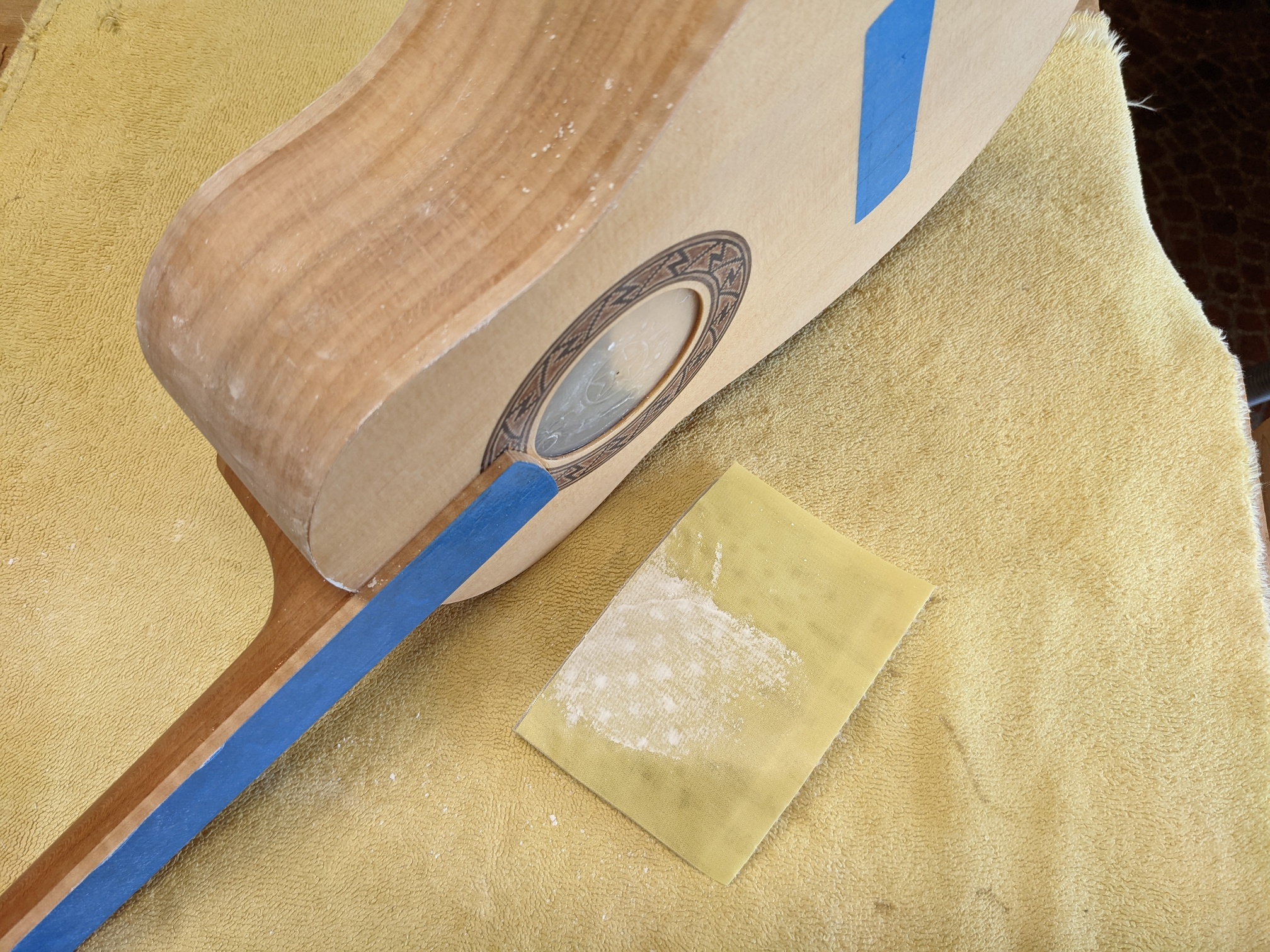
What’s really remarkable about the sheets is their aggressive cut, even while leaving a smooth finish. Eagle claims that the 600 grit Super Assilex sheets, for example, cut as aggressively as regular 320 grit sandpaper, while leaving a 600 grit finish. My experience supports this – the cut is way faster than standard 600 grit, but the finish is as smooth. This results in a fairly rapid build-up of finish powder during sanding, which needs to be brushed or vacuumed away. The sheets themselves can also be brushed or vacuumed to remove any powder that is sticking to the surface. Figure 2 shows the amount of powder generated from just a little bit of sanding with the 800 grit sheet, using a soft backing pad without the sanding block.
One thing I’ve noticed is that the sheets are so thin and flexible that they’ll closely follow the contours of the sprayed surface if a flexible backing pad is used. While this can be helpful if the surface isn’t perfectly flat (as is often the case for the sides of a guitar), it can actually make it difficult to sand out runs or sags in the finish to level the surface. The surface of the sheet will conform to the ups and downs of the sags rather than riding on top of the peaks and sanding them level. It can thus look like the surface has been leveled, since it will have a uniform matte finish, without the low spots showing as glossy; however, buffing will result in a shiny but wavy surface since the bumps from the sags are still there. This can be dealt with by using the sanding block without a backing pad to level the runs/sags/orange peel, and adding the pad once the bumps are gone.
This sandpaper has really been helpful in changing my attitude toward finishing – I actually now enjoy it since I’m spending significantly less time sanding. The only downside of Super Assilex is the cost – the starter kit runs about $80 on Amazon for 5 double sheets of each the 5 grits from 600 to 1500, plus the sanding block and pads. I added to the finishing kit by purchasing some 320 grit sheets for use in sanding between coats and initial leveling. The single-grit packages are a little less expensive, at $50 for 25 double sheets, but that still comes out to about $1 per sanding-block-sized piece of sandpaper. On the other hand, each half-sheet of the 600 through 1500 grit seems to last for at least a couple of guitars. I use about one 320 grit half-sheet per guitar since it does the main work of leveling; given my spraying prowess, there’s always lots of that to do. Super Assilex is also available in sanding disc form for power sanding, but given how fast it cuts by hand I’m not sure I’d have the courage to try those.
References
Super Assilex Flexible Sanding Sheet Finishing Starter Kit, SP19115
Super Assilex Flexible Sanding Sheets, Ocean K-360, Hook & Loop, 191-1515, 25 Sheets